| |
|
|
 |
 |
|
Please feel free to read and explore the materials in this section. If you are doing research and need help with something, we will try to assist you in any way we can. If you would like us to post something you have written, please contact us at : [email protected]. We will do our best to post all relevant materials; however, we reserve the right not to post your submission if we feel it is inappropriate.
Please note that anything downloaded from this site may not in any way be altered or reproduced without written permission from the author or artist. Thank you! |
|
All | News Articles | Documents | Laws & Regulations | ASK Publications | Video | Misc.
|
|
|

A Channel NewsAsia
November 1, 2008
Korean adoptees meet birthparents at homecoming
By Channel NewsAsia's Korea Bureau Chief Lim Yun Suk | Posted: 20 August 2008 0056 hrs
SEOUL : In recent years, South Korea has been promoting domestic adoption - partly to downplay the "baby exporting country" label.
For the first time last year, the number of babies adopted in the country exceeded the number sent overseas.
Recently, a group of South Koreans who were adopted overseas, made a trip back home to find out more about their motherland.
An adoptee-run non-profit programme called GOAL (Global Overseas Adoptees Link) held the gathering in Seoul for the Korean adoptees from around the world.
Daewon Wenger, secretary general of GOAL, said: "One of the main purposes of GOAL is to raise the awareness of Korean adoptees actually returning to Korea within the Korean society.
"The problem is the adoptees look like Koreans because we are all born in Korea, but they grew up abroad. But once they come back, many Koreans don't realise that Korean adoptees are back in Korea."
The gathering was an emotional event for some, when they met their natural parents.
Rachel Y Lawler, a Korean adoptee, said: "I went for 23 years without knowing her (my mother), knowing what she looks like. It was strange in some ways because she was absent from my life for 23 years. But now that I have met her, I hope to continue some sort of relationship and go from here.
"I know I can't make up for the 23 years that she was not in my life, but we can hopefully establish a good relationship now."
Since the end of the Korean War in 1953, about 160,000 South Korean children have been given up for adoption overseas, earning South Korea the label of "baby exporting" country.
At its peak, some 7,000-8,000 children were adopted by foreign families every year, but now that number has since dwindled to less than 2,000.
South Korea is promoting adoptions at home and for the first time last year, adoptions by Korean families exceeded those by foreigners.
The majority of Korean children being given up for adoption are not orphans, but are children of single mothers. Single mothers are still being looked down in the Korean society, and it is not easy for them to raise their children, forcing some to give up their children
Kim Stoker, a representative of Adoptee Solidarity Korea, said: "We would like to see some social welfare change, especially by the government, to provide support so that these women are able to keep their children.
"International adoption is not a viable option anymore in Korea. We think Korea is economically developed enough and that the government can provide social services for its people. The children and babies are part of this society."
Currently, South Korea sends the world's fourth largest number of babies abroad, with China in the lead, followed by Guatemala and Russia. - CNA /ls
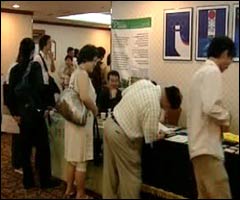
Photo:
Koreans who were adopted overseas.
 http://www.channelnewsasia.com/stories/eastasia/view/369774/1/.html http://www.channelnewsasia.com/stories/eastasia/view/369774/1/.html
|
  |
|
|
|
|
|
|
|
|
|
|
|
|
|
 Name Search



 Adoption Mosaic: Interview with Kim Park Nelson Fall 2008
 Korean-American Academics to Throw Light on Adoption 2008.10.29